

Relying on a single salary or a single business is one of the biggest financial risks most families take without realising it. If that one source slows down, everything else is affected: your goals, your investments and your peace of mind.
Passive income planning is the practice of building additional streams of money that keep coming in without needing your daily time and effort. This guide explains how it works, what is realistic, and how mutual funds can help you create dependable income over the long term.
What Is Passive Income Planning?
Passive income is money that arrives with little ongoing effort, such as interest, dividends, rent or regular withdrawals from an investment portfolio. Passive income planning means deciding in advance which streams you want, how much capital or effort each needs, and how long it will take to build them.
One honest point first: passive does not mean effortless. Most passive income needs upfront money, time or discipline before it starts paying. A portfolio that pays you a monthly amount in your fifties is usually the result of regular investing in your thirties and forties.
Why One Income Stream Is Not Enough
A single source of income leaves you exposed to job loss, a business slowdown, illness or a sudden expense. Multiple income streams give you a safety net and more freedom of choice.
They also help you stay ahead of rising prices. Over the years, the cost of living keeps climbing, and income that does not grow loses buying power. Our article on how inflation impacts your savings explains why money sitting in one place or one account struggles to keep up.
Common Types of Income Streams
A healthy mix usually includes sources that behave differently from each other:
-
Earned income: your salary, profession or business profit.
-
Portfolio income: returns from investments such as mutual funds, bonds and deposits.
-
Rental income: rent from a property you own, though it needs significant capital and ongoing upkeep.
-
Business or side income: freelancing, consulting or a small venture that runs alongside your main work.
No single stream is perfect. The aim is to reduce your dependence on any one of them, and portfolio income is often the easiest one to build gradually because you can start with small monthly amounts.
Building Portfolio Income With Mutual Funds
Mutual funds offer several practical ways to create income, depending on your goals and how soon you need the money.
1. Grow the corpus first with SIPs. A Systematic Investment Plan builds your capital through regular monthly investing. The larger the corpus, the more income it can support later. If you are deciding how to invest, our guide on SIP vs lump sum investment can help.
2. Use a Systematic Withdrawal Plan (SWP) for regular income. With an SWP, you withdraw a fixed amount from your mutual fund at set intervals, for example every month. The rest of your money stays invested. This gives you a steady cash flow that works much like a salary, and you decide the amount and the frequency.
3. Consider debt and hybrid funds for stability. Debt funds and hybrid funds can suit people who want steadier, lower-volatility income, especially closer to retirement. Choose based on your time horizon and risk comfort.
4. Treat IDCW payouts with care. Many funds offer an Income Distribution cum Capital Withdrawal (IDCW) option, previously called the dividend option. These payouts are not guaranteed, and a payout can reduce the fund's value, so they are not the same as fixed income.
If your goal is income after you stop working, you can read more in our complete guide to retirement planning in India.
How Big a Corpus Do You Need?
The table below is illustrative and shows the corpus needed to support a monthly income of ₹50,000 (₹6 lakh a year) at different withdrawal rates. These rates are assumptions, not promises, and the sustainable rate depends on returns, inflation and how long you need the income to last.
|
Annual withdrawal rate |
Approximate corpus needed |
|
3% |
₹2 crore |
|
4% |
₹1.5 crore |
|
5% |
₹1.2 crore |
A lower withdrawal rate is more conservative and leaves more room for the corpus to last, while a higher rate needs a smaller corpus but puts more pressure on it, particularly in weak markets.
A Step-by-Step Approach to Passive Income Planning
-
Secure the base first. Build an emergency fund and make sure you have adequate life and health cover. Our guide on emergency fund planning shows how much to keep aside.
-
Reduce expensive debt. High-interest loans can cancel out the benefit of any income you build.
-
Start a SIP and automate it. Even a modest monthly amount, raised every year, adds up over time.
-
Add a second stream gradually. This could be a side income, a rental or a growing mutual fund portfolio.
-
Plan how and when you will draw income. Decide whether an SWP or another method fits, and set a sensible withdrawal rate.
-
Review every year. Check that your income streams, goals and investments still match your life.
Common Mistakes to Avoid
-
Chasing high payouts. A very high promised return usually means high risk.
-
Starting withdrawals too early, before the corpus has had time to grow.
-
Putting everything into one asset, such as property or a single fund.
-
Ignoring inflation, so that income that looks sufficient today falls short in future.
-
Skipping insurance, which leaves your income plan exposed to one medical or family emergency.
Build Income Streams That Last
A good income plan starts with your goals and how much risk you are comfortable with. At Shah Finserv, we help families and business owners across Vapi, Valsad and nearby areas plan mutual fund investments for both growth and regular income. Explore our mutual fund services, or contact us to build a plan that fits your needs.
Related Blogs
-
October 27, 2026
7 Personal Finance Ratios Everyone Should Track for Financial Health
-
October 13, 2026
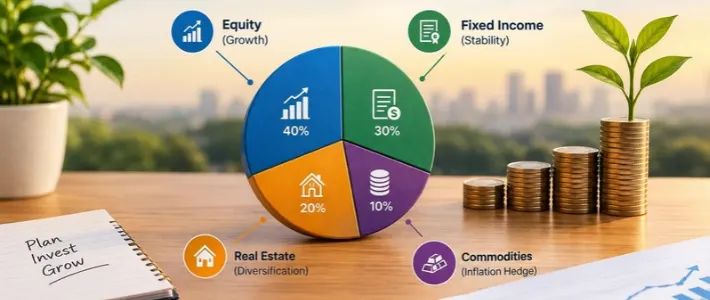
Understanding Asset Allocation for Long-Term Wealth Growth
-
August 20, 2026

Financial Planning Before Applying for a Home Loan
We Deals In
















Frequently Asked Questions
It is the process of setting up income sources, such as investment returns, rent or regular withdrawals, that need little daily effort once built. It involves choosing the sources, estimating the capital needed and building them over time.
Only partly. Most passive income needs upfront capital, time or discipline before it starts paying, and it still needs periodic review. It becomes less hands-on once it is set up.
Mainly through an SWP, where you withdraw a fixed amount at regular intervals while the remaining money stays invested. Some funds also offer IDCW payouts, but these are not guaranteed.
It depends on your goal, timeline and risk comfort. A practical approach is to work backwards from the monthly income you want, estimate the corpus needed, and then set a SIP amount you can sustain and increase yearly.
As early as possible. Starting early gives your investments more time to grow, so smaller monthly amounts can build a larger corpus than starting late with larger amounts.